The Feng Shui & the Tango Trilogy
Feng Shui and the Tango #1
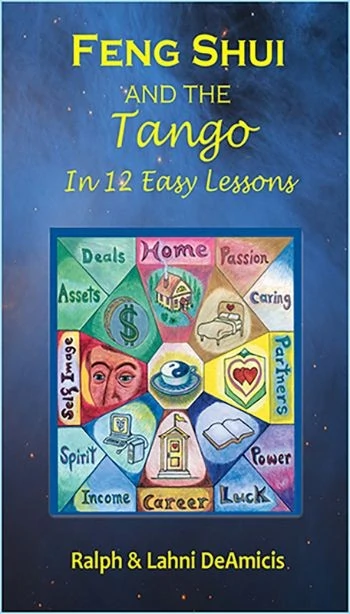
This art is both mystical and practical, and its applications in modern environments can be shockingly effective at resolving issues. This three book series was the foundation texts for Ralph and Lahni's long running school on Feng Shui and Ergonomics. It weaves together Asian and Western environmental design offering real world solutions to common, and uncommon problems. In 'Tango' the history of Feng Shui is covered, along with its connections to Western Astrology. Then the main tools are explained with examples. This is Feng Shui for the modern world.
Happiness Lessons #2

This is Part Two in the three-book series from Ralph & Lahni’s Feng Shui and Ergonomic Design course. It addresses issues that show up in the home and relate to the personal life. This approach to healing design mixes techniques from Asian and European systems to help you create the life you want. These well tested, highly effective solutions, based on ancient principles, are supercharged with current research from ergonomics and energetic kinesiology. This approach is like a chocolate dipped fortune cookie; it embodies the American genius for synthesizing practical and entertaining innovations for our future focused society.
Prosperity Lessons #3

This solution-based book explains how the program of money is created in your life and how you can upgrade your potential. It gives helpful insights about those critical crossroads where money is on the table and opportunity is in the air. It includes finding building sites, house sales, office design and creating income energy.
A Women's Bagua

The Feng Shui that came to the west after China’s cultural revolution was limited and very patriarchal. This is a problem because ninety percent of American practitioners are women, so the tool does not allow them to use their full talents. Historically, the ‘great knowledge’ of geomancy and astrology was kept in the circle of professionals around the Emperor who shared parts of that knowledge with the Mandarins. But this secular system which guided road building, city planning and military campaigns was mostly destroyed by the infamous Red Guard.The evidence of this is in the Bagua which most people use. Why does it only have eight sides? Most of the other systems are based on twelve. There are twelve Animal Years, which are based on the position of Jupiter traveling through the twelve Signs. In Chinese Medicine there are twelve meridians along which the life force flows. In the laws of midday and midnight, which times the activity of the organs, there are twelve time periods. Why do we call this a Woman’s Bagua? Because men often abhor complexity while women embrace it. There are angles that are masculine and others that are feminine, and the eight part map is dominated by masculine angles. In the twelve part map they are balanced, and you can energetically connect segments together in ways that celebrate the Goddess. 164 page, $19.95
Feng Shui and the Tango, The Essential Chapters
.jpg)
Sometimes you just want to explain to people that if they can manage these basic issues, everything will tend to get better. It may not be perfect, there can be hidden factors, but better!
So we took seven important, yet basic chapters and put them into this little book. We often send it to clients after a consultation along the audio of video file of the session. Many times the consultation was about Astrology, or AstroCartagraphy or Location, but we realized that some Feng Shui solutions would be a big help. 106 pages, $17.00
The Clutter Bug's Emergency Handbook

Coming Soon